

Blog|Articles|September 24, 2026
Could Photon-Counting CT Expose the Paradox of Health-Care Economics?
Author(s)Filippo Cademartiri, MD, PhD
While better imaging may reduce the need for additional diagnostic tests, it may also eliminate the reimbursement that comes with those additional tests.
Advertisement
What if photon-counting CT (PCCT) is too good?
Health care says it wants diagnostic certainty. But many health-care systems still pay for activity, not for information.
Therein lies the paradox.
A diagnostic test with substantial uncertainty — particularly one generating false-positive or inconclusive results as may occur with functional testing in selected populations — often creates a certain cascade:Test → uncertainty → another test → imaging → invasive angiography → more procedures.
Every step generates activity.
Now consider the opposite model. A highly accurate cardiac CT examination — increasingly so with PCCT — can provide detailed coronary anatomy, plaque characterization and spectral information while potentially reducing equivocal findings and unnecessary downstream testing.
One examination. More information. Less uncertainty. Fewer additional tests.
Clinically, that sounds like progress. But is that the case in a fee-for-service system?
It creates an uncomfortable economic paradox. Uncertainty generates procedures. Diagnostic certainty may eliminate them.
This doesn’t mean physicians deliberately choose inferior tests to generate revenue. The problem is more structural. A system that rewards the number of procedures may inadvertently assign greater economic value to a diagnostic pathway that generates additional procedures as opposed to one that solves the clinical question immediately.
Perhaps the real disruption of PCCT will not be spatial resolution, spectral imaging or dose reduction. It may be exposing a fundamental contradiction in health-care economics.
We say we want diagnostic certainty but are we actually paying for it?
Dr. Cademartiri is the director of advanced cardiovascular imaging and photon-counting CT at the Scientific Institute for Research, Hospitalization, and Healthcare Synlab Diagnostic Network in Naples, Italy. He is also a consultant in advanced cardiovascular imaging at CDI/Centro Diagnostico Italiano in Milan, Italy.
(Editor’s note: This blog is adapted with permission from Dr. Cademartiri’s original LinkedIn post available at
Advertisement
Related to this article

Catch up on the top radiology content of the past week.
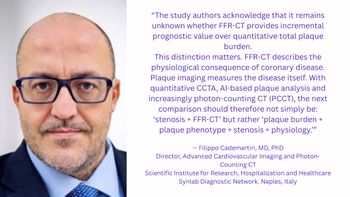
Does fractional flow reserve (FFR) or quantitative plaque burden from CCTA provide greater prognostic insight into coronary disease?
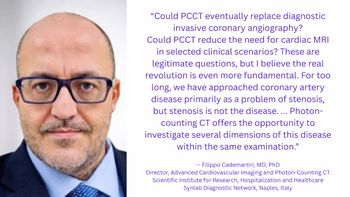
While a new article raises provocative questions about the capability of photon-counting CT (PCCT) to perhaps replace diagnostic ICA, the real revolution with this modality is going beyond stenosis measurement to a renewed focus on the disease of atherosclerosis.

Has the barrage of passwords, PINs and authenticator apps gone around the bend to a point where it hampers efficiency and productivity?

Catch up on the most well-viewed video interviews from Diagnostic Imaging in September 2026.
Catch up on the top radiology content of the past week.
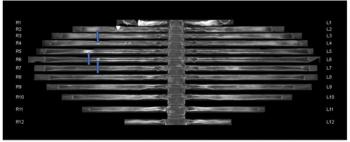
The use of adjunctive CT bone reading software in women with breast cancer detected between 8 to 22 percent more metastatic lesions for reviewing radiologists and reduced CT interpretation time by 50 percent or more, according to a new study.

How will generative AI software be evaluated by the FDA in the future? What’s next for point-of-care ultrasound? What steps have been successful in facilitating adoption of AI applications across enterprise systems? Leaders in radiology and health care will be discussing these topics and more at the upcoming HLTH USA conference.
Advertisement
Advertisement
Trending on Diagnostic Imaging
1
What a Large Prostate MRI Study Reveals About AI and Unassisted Radiologist Assessment
2
FDA Clears First MRI-Derived AI Software for Assessing Breast Cancer Recurrence Risk
3
Research Highlights from the ASTRO 2026 Annual Meeting
4
How Photon-Counting CT Helps Us Recognize that Coronary Stenosis is Just One Piece of the Puzzle
5