In the second of a two-part podcast episode, Lauren Nicola, MD, Christoph Wald, MD, PhD, MBA, and Peter Shen discuss challenges with evaluating value and ROI for AI software, the physician time required to do so, and possible solutions to facilitate improved clarity and consistency with AI reimbursement.
Advertisement
There is a considerable array of challenges with AI implementation in radiology workflows, according to Christoph Wald, MD, PhD, MBA. In a recent Reading Room podcast, Dr. Wald noted the possibility that the scanning inputs and population the AI software was trained on may not be generalizable to your practice’s population, legacy PACS systems that offer “no real mode of operation” to test AI software, integration into radiology reporting, staff training and post-implementation monitoring.
“There's a whole host of activities that have to occur in order to responsibly incorporate this technology into practice,” maintained Dr. Wald, an abdominal radiologist at the Mayo Clinic in Rochester, Minn., and chair of the board of chancellors for the American College of Radiology (ACR).
Should Radiologists be Compensated for the Work That Goes into Evaluating and Monitoring AI Software?
Concurring with Dr. Wald, Lauren Nicola, MD, said assessment, integration and post-deployment monitoring involves significant radiologist time and effort that warrants appropriate compensation.
“What we've been trying to do in the ACR economics team is to help Medicare realize that that is physician work, right? It may not be per-patient work per se, but it's work. It's physician work that should be compensated and reimbursed,” noted Dr. Nicola, the chair of the Economics Commission for the ACR, and CEO of Triad Radiology Associates in North Carolina. “ … We're doing it to improve the quality of care for our patients, and it's extra effort that we could otherwise be putting toward other revenue-generating things.”
How Does One Assess the Value of AI in Lieu of Reimbursement for the Majority of AI Software Products?
Artificial intelligence is also a tricky value proposition beyond ROI for AI software modalities, the vast majority of which do not have Category I CPT codes.
“I think it gets extra complicated because ROI to whom, right? The hospital is sometimes the purchaser of AI products. Sometimes the physicians are the ones using it. The patients are sometimes the ones paying out of pocket for it. Sometimes they're the beneficiaries of whatever it is that the product is. So guaranteeing that there's an ROI is a really complicated and distorted economic question because it's hard to know who the consumer is in a lot of cases,” explained Dr. Nicola.
Indeed, there are multiple stakeholders involved and Dr. Wald noted different kinds of value with AI software, whether it’s in the form of efficiency gains, shortening time to treatment with AI-assisted triage and risk stratification.
“There's operational value, there's individual patient care value, there's efficiency value (and) there's long-term population value that might be interesting to a payer. … It's multi-stakeholder and really needs to be unpacked carefully. What value and to whom does it accrue, and who's paying the bills for the direct and indirect costs of AI implementation?,” posited Dr. Wald.
What Steps Can Be Taken to Help Address Adoption and Reimbursement Challenges with AI?
Are there possible solutions to the reimbursement quandary with AI? Dr. Wald envisions a possible network to facilitate post-deployment monitoring that may help mitigate the risk of releasing new technology into health care and foster more rapid adoption of technology.
Dr. Nicola suggested that eliminating the budget-neutral cap on the physician fee schedule may enable more room for growth and innovation with AI. She pointed out the lack of a similar budget cap with the Hospital Outpatient Prospective Payment System (OPPS), where quantitative AI algorithms have seen more traction with reimbursement.
“ … That really creates an interesting dichotomy in that the innovations that are incentivized in the hospital facilities are not simultaneously incentivized in the physician office setting, which, for one thing, pushes care to the higher-cost-of-care side of service payments. It just makes this odd discrepancy that I think creates even more barriers than already exist,” maintained Dr. Nicola.
Peter Shen added that the medical technology industry has introduced legislation in Congress that may encourage more consistent and predictable reimbursement in the future with AI algorithms.
“We want to encourage bodies like CMS (Centers for Medicare and Medicaid Services) to really put some focus on this going forward to create that consistency and predictability. I think the good news here is that we are starting to see positive direction. I think with the proposed physician fee schedule that’s coming next year, there’s new acknowledgement now from CMS that they (will) look at this topic further,” noted Shen, the global head of commercial operations and senior advisor for digitalization and AI at Siemens Healthineers.
For more insights from Dr. Nicola, Dr. Wald and Peter Shen, listen below or subscribe on your favorite podcast platform.
In the second of a three-part podcast episode, Wendie Berg, MD, PhD, FACR, FSBI, Manisha Bahl, MD, and Amy Patel, MD discuss how to handle disagreements with adjunctive AI in breast imaging, whether to include AI assessments in PACS, and whether patients should pay for the use of adjunctive AI.
In a new podcast episode, Joseph Cavallo, MD, MBA, offered his perspective on AI integration, potential efficiency gains, navigating post-deployment monitoring and how to incorporate AI literacy into radiology resident training.
How will generative AI software be evaluated by the FDA in the future? What’s next for point-of-care ultrasound? What steps have been successful in facilitating adoption of AI applications across enterprise systems? Leaders in radiology and health care will be discussing these topics and more at the upcoming HLTH USA conference.
In the third of a three-part podcast episode, Wendie Berg, MD, PhD, FACR, FSBI, Manisha Bahl, MD, and Amy Patel, MD discuss recent developments with autonomous AI in breast imaging and share their perspective on the overall potential of AI to help mitigate the radiologist shortage.
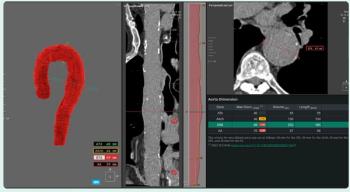
The newly cleared Aview Aorta Metrics software reportedly offers automated segmentation of aortic regions and classification of aortic zones based on chest CT images.
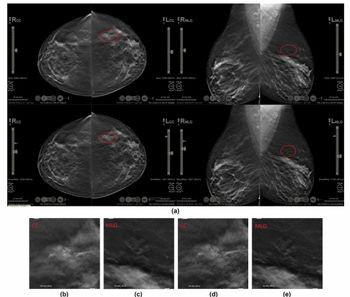
Use of the AI-enabled slab technology from reconstructed DBT imaging led to a 7.4-second mean reduction in reading time in a new study involving 391 cases and 15 reviewing radiologists.