Articles by Greg Freiherr

The new generation of wide CT detectors provides expanded coverage, allowing faster scans and even dynamic imaging of organs, including the heart and brain. Where the onetime state-of-the-art 4-cm coverage takes four steps to cover the heart, detectors spanning 8 cm require just two. Toshiba’s 16-cm-wide, 320-channel detector captures the heart in one. But there are disadvantages.
Some of the best deals in medical imaging today can be found in the CT market. Vendors are desperate for your business.
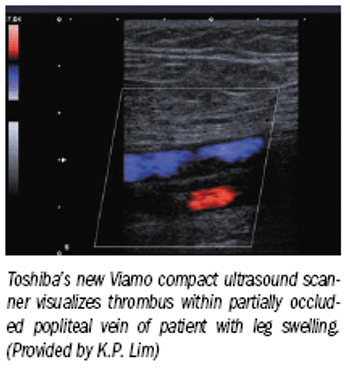
Philips and Toshiba have joined ultrasound vendors looking to cash in on physicians' love of good things that come in small packages.
Barely three months after the Dutch High Flux Reactor at Petten in the Netherlands came back on line -- ending a half-year hiatus that threw a monkey wrench into the world supply of the technetium-generating molybdenum radioisotope -- practitioners of nuclear medicine are facing a new crisis. A shutdown at the Canadian nuclear reactor at Ontario’s Chalk River less than two weeks ago threatens to cut in half the supply of technetium to sites in the U.S.
Software that improves image quality is on track to be a champion of CT dose reduction now and in the future.
The floodgates of advanced processing sprang wide Wednesday, unleashing a three-hour torrent of 2D and 3D renderings from eight workstations in what has become an annual event at the International Symposium on Multidetector-Row CT.
Lately our political system has taken on religious trappings. We are asked to have faith in our institutions, in the leaders we elected, in our values…faith that these eventually will get us back to normalcy. In the long run, I have no doubt they will. It’s the near term that worries me.
Training trumps experience when it comes to interpreting CT colonography, said Dr. Abe Dachman, director of the Fellowship Programs at the University of Chicago Medical Center.
Chinese Hospital is dedicated to serving patients of Chinese descent in San Francisco. By integrating advanced processing techniques and scheduling, its Carestream RIS/PACS helps the hospital make the most of its resources. Greg Freiherr has the story from San Francisco’s Chinatown.
The new generation of wide CT detectors provides expanded coverage, allowing faster scans and even dynamic imaging of organs, including heart and brain. There are disadvantages, said Dr. Mathias Prokop, speaking May 19 at the 11th International Symposium on Multidetector Row CT, but these are minor in comparison.
A smorgasbord of challenges face radiology but few present a greater threat than the “invisible radiologist,” said Dr. Gary Glazer, chairman of the Stanford University radiology department, who kicked off the 11th International Symposium on Multidetector-Row CT.
One of the first proven applications for multislice CT was trauma, a clinical role affirmed by past International Symposia on Multidetector-Row CT and the one going on now in San Francisco. Over the last several years, however, another issue -- patient radiation dose -- has surfaced, calling some MSCT applications into question. Any concerns about radiation dose are vastly outweighed, however, by the benefits of CT when it comes to dealing with trauma patients.
As researchers and clinicians gather to discuss the latest developments in advanced CT imaging, it is ironic that the new capabilities on exhibit here could become more affordable than ever for those in a position to acquire them.
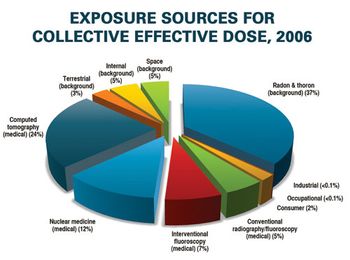
Over the past quarter century, exposure to ionizing radiation from medical procedures in the U.S. has grown sevenfold, according to the National Council on Radiation Protection and Measurements. CT is a major source.
Over the past quarter century, exposure to ionizing radiation from medical procedures in the U.S. has grown sevenfold, according to the National Council on Radiation Protection and Measurements. CT is a major source.
CT exams are not routinely ordered for pregnant women, but may be necessary to detect suspected life-threatening conditions, such as bleeding in the brain, blood clots in the lungs, or appendicitis. The use of CT to do such studies has grown enormously over the last decade. A study published March 17 in the online edition of Radiology found that CT exams on pregnant women increased 25.3% per year from 1997 to 2006.
It’s bargain hunting time in the MR world, and there are plenty to consider. New systems operating at 1.5T can be had for under a million dollars. A million and a half will buy you a new system tricked out with about any application within the reach of that field strength. This is a bargain in itself, considering how much more a new 1.5T can do today than it could five years ago -- for about the same price.
GE launched today Healthymagination, a six-year initiative that will redirect half of its $1 billion healthcare R&D budget toward driving down the cost of healthcare while boosting access to improved care through technology and service innovations in the U.S. and around the world.
Corporate sponsorships are as American as apple pie. Ace Hardware sponsors Little League baseball and softball. Microsoft sponsors the National Center for Missing & Exploited Children. Dow helps put shoes on the feet of needy kids through contributions to Soles4Souls. Toyota underwrites an elementary school multimedia show for Mothers Against Drunk Drivers.
Habits run our lives. Some are good. We reach to the left of a faucet when we want warm water and to the right for cold; slam on the brakes when a ball skitters from a playground into the road; tie our shoes when they come undone. But not all habits are good, and even ones that have served us well can go wrong if they don’t evolve.
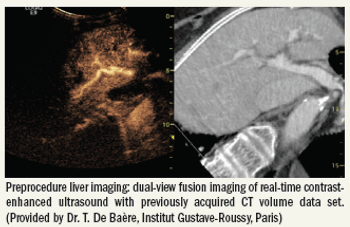
Philips and Toshiba hope to open up a new end of the market for hand-carried ultrasound-the high end.
Technology can be distracting. Just try talking to a teenager holding a cell phone or an iPod. To be fair, teenagers are not the only ones. A day doesn’t go by when I don’t see someone driving and talking on a cell.
Investigators from the U.S. Department of Defense executed a search warrant April 22 at the Malvern, PA, office of Siemens Medical Solutions USA, seeking evidence of wrongdoing associated with a government contract between the DoD and Siemens.
Of all the things uttered by President Clinton, the best remembered may be his questioning of what “‘is” is, an ignominious line prompted by an investigation that led eventually to his impeachment. Today that question can be legitimately asked with only a change in capitalization and pronunciation as the information technology world questions the significance of IS (information systems).
Automation is the grease that makes workflow glide. Single clicks and macros are lesser elements of this process. The real gains are made under the covers of IT systems by algorithms with preprogrammed agenda. Far more intelligent tools than these will soon be needed to handle the wave of EMRs gathering off the shores of U.S. healthcare.
In the boom leading up to sequencing of the human genome, genetics and legal experts debated the ownership of the data contained within the double helix. Now, as the U.S. readies for a surge into healthcare IT, a similar debate has broken out over EMRs. The outcome could be critical to making the best use of the huge amount of electronic medical information that the Obama Administration’s stimulus funding will create in the next few years.
Newly christened AccelaRAD unveiled at HIMSS 2009 a service that allows patients unprecedented control over their medical images. The service, called SeeMyRadiology.com, is designed to provide patients the opportunity to create personalized libraries of images in a centralized location. Using this service, patients own their digital medical images, choosing which ones to easily and securely share with whom, particularly physicians.
The weakened U.S. economy is slowing the pace of growth in healthcare IT, according to a survey conducted by HIMSS. Only a little more than half (55%) of the 304 respondents participating the 20th annual HIMSS Leadership Survey said their IT budgets would increase, compared to 78% last year. This year about 42% said their staffing levels would increase, down from 68% last year.
The debate over “meaningful use” has begun. At stake is nothing less than the success of President Obama’s initiative to turn paper into electronic medical records.
There’s no more natural way to convey information than speech and arguably no more difficult interface or a computer to capture. Agfa has come up with a couple new twists to help. Viztek takes a swing at tighter integration between PACS and EMRs, while IT specialists include first responders in the chain of medical communications and refine ways for providers to keep on top of their financials.