Articles by Greg Freiherr

Procedures to ensure patient privacy don’t do much if the patient data end up on portable electronics. This happens more commonly than might be expected, according to a survey reported at the 2009 Healthcare Information and Management Systems Society meeting in Chicago.
Unnecessary or inappropriate diagnostic procedures are not only costly, they can be dangerous. X-ray based procedures expose patients to radiation. Ones involving contrast media present the danger, albeit slight, of an adverse reaction. Many are the result of ineffective communication among healthcare providers.
As other medical imaging vendors are tightening their belts, NovaRad is racking up sales, installing five to eight RIS/PACS a month. And it’s not a passing thing, according to Paul Shumway, NovaRad vice president of operations and marketing. He expects the firm to maintain this pace through 2009. The reason? The company’s RIS/PACS help hospitals and imaging facilities minimize costs and maximize profits.
Procedures to ensure patient privacy don’t do much, if patient data end up on portable electronics. This happens more commonly than might be expected, according to a survey conducted by Credant Technologies, a Dallas-based firm specializing in data protection solutions.
Fujifilm Medical Systems USA has expanded its Synapse Managed Services to include RIS hosting and tele-RIS capabilities through a partnership with Evolved Digital Solutions.
The makers of electronic medical records have never been happier. For the first time, their technologies are glitzier than MRs and CTs. The federal government is gearing up to reimburse the use of HIT products with an entitlement program that will award fees similar to those given the users of high tech medical scanners. And the result could be an enormous boon to the adoption and use of healthcare IT. But as vendors get ready to slide new servers and archives into place, are they also unwittingly laying the plans for a trap door that will lead medical practice down a path no one would consciously choose?
The road to profit goes through a tiny burg called accuracy, which is sometimes harder to find than it should be. Vendors on the HIMSS09 exhibit floor offered their own kinds of medical GPS, some using off-the-shelf technologies spun up with a proprietary brand of software, others offering home brewed data handling techniques.
Carestream wants to involve patients more in the healthcare process. New products shown in the company’s booth at HIMSS09 selectively delegate administrative duties to patients, duties that the patients are uniquely suited to handle.
Agfa repackaged its RIS and PACS into “Enterprise Visualization” at HIMSS 09, a concept designed to cover every imaging based technology from radiology to pathology, fluoroscopy to endoscopy. The concept is designed to appeal to hospital chief information officers seeking a turnkey solution to an increasingly data intensive problem. It will be especially attractive to the owners of legacy PACS who now are looking for a way to update their IT approach to meet evolving needs that stretch across the enterprise.
Efforts by the Obama Administration to make healthcare more efficient will succeed only if an efficient way of connecting different healthcare IT systems can be found, an objective that could get tougher as more institutions adopt IT. The challenge will be getting the different types of systems to talk to each other.
RIS and PACS vendors saw it coming a long time ago, a need to make data repositories work with IT the systems that drive workflow. The hybridization of RIS and PACS, preceded by interfaces that allowed the transfer of data between and among systems by different vendors, blazed a trail toward interoperability. This trail has now fanning out to super highway status to accommodate the spread of companies seeking to provide answers to IT questions that must be answered if the Obama initiative is to improve the efficiency of U.S. healthcare.
Portal-driven workflow is setting a new standard in IT, according to Siemens Healthcare. Its role-based syngo portals addresses these standards, serving as access points to imaging information and context-sensitive tools, according to the company.
The HIMSS 09 exhibit floor opened Sunday as thousands of IT enthusiasts descended on McCormick Place in Chicago. Mammoth exhibit halls packed in November with imaging equipment played host to myriad information technologies, some focused on the core of healthcare IT – switching, translating and archiving packets of data; others addressing the consequences of IT adoption.
The Obama Administration has singled out healthcare IT as a catalyst for the remaking of U.S. medical practice. Hundreds of healthcare IT companies are converging on Chicago, bent on explaining how they and their technologies can make it happen quickly, efficiently, cost effectively. Some will do so exclusively at their booths on the HIMSS 2009 exhibit floor. The better connected will leverage symposia, summits and workshops; hold luncheons; host media briefings.
The debate between GE and Bracco over GE’s marketing of its Visipaque contrast agent continues despite a U.S. District Court finding that GE used false advertising to win sales for the x-ray contrast agent.
You’d think that a society such as ours, one steeped in the Internet and awash in cell phones and iPods, would gravitate toward electronic health records. But, in what has been framed as the first nationally representative study of EHR prevalence in hospitals, researchers in Boston and Washington, DC, found that less than 2% of U.S. hospitals have so far implemented comprehensive EHRs. Less than 8% have even basic EHRs in place.

Economic issues beyond the imagingcommunity affect sales of imagingequipment.
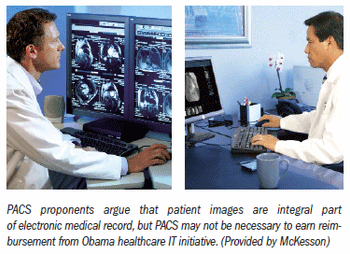
Like many parts of the Obama administration'sstimulus plan, the $19 billion setaside for healthcare IT contains manyuncertainties.
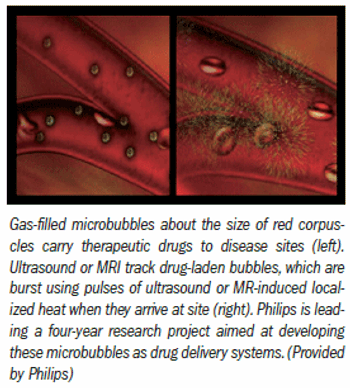
A consortium of more than a dozen European companies and universities is exploring the use of ultrasound and MR to guide or even unleash therapeutic drugs.
GE Healthcare is on the hook for $11.4 million to Bracco Diagnostics after the U.S. District Court for New Jersey ruled that GE used false advertising to win sales for its x-ray contrast agent Visipaque over Bracco’s Isovue agent.
With stock prices at lows not seen in a decade, the imaging industry is primed for a wave of mergers and acquisitions. That it hasn’t arrived yet is due mostly to liquidity problems, which will ease in the next six months or year. The only question then will be what the industry will look like when this wave washes over it. I’m betting it will look eerily similar to what it is today.
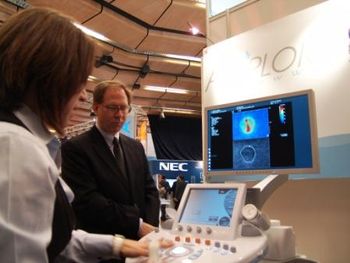
It wasn’t too long ago that ultrasound was a roiling sea of innovation and new product releases, spurred by a rivalry among Diasonics, ATL, Hewlett-Packard (Agilent Technologies), and Acuson. Since these companies’ acquisition by GE, Philips, and Siemens, the waters have calmed. Supersonic Imagine plans to begin making some waves -- and soon.
TeraRecon’s advanced visualization product came to the ECR exhibit floor equipped with new tools and enhancements to some of its old ones.
The latest version of CT colonography software from Medicsight debuted this week at ECR 2009.
Philips and Toshiba hope to open up a new end of the market for hand-carried ultrasound – the high end.
Philips Healthcare says it has come up with a way to make imaging departments more productive, at least ones that use its MR and CT scanners.
Computer aided detection remains the core focus of iCAD, but the company, once known only for its mammography products, has a much broader portfolio these days.
Focusing on company technologies aimed at early stage diagnosis, GE Healthcare is advocating disease prevention and presymptomatic detection at the ECR this week. In the context of this “Early Health” model of care, GE addressed an issue Europeans were the first to be concerned about: patient radiation dose.
Siemens cast its work-in-progress 16-slice PET/CT at the nexus of vision and value.