
The bits and pieces that make digital radiography are center stage at the Varian Medical Systems booth.
The bits and pieces that make digital radiography are center stage at the Varian Medical Systems booth.
IT provider medavis is taking radiology information systems to task.
The new owner of Visage Imaging, Pro Medicus, is showing a jewel in its new crown.
Definiens introduced its latest CAD system as a way to judge the effects of therapy on some cancer patients.
A less powerful version of Toshiba's flagship Aquilion One CT scanner appeared at its first tradeshow this week in Vienna.
Having completed the sale of its 3D visualization unit to Toshiba Medical earlier this year, Barco projected a new , more concentrated look at ECR 2009.
Agfa HealthCare is showcasing its new DX-D line of digital radiography systems at ECR 2009.
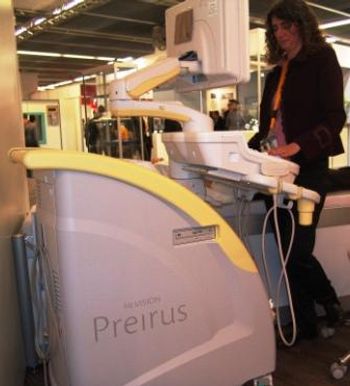
Friendly technology for operators and patients is Hitachi Medical’s theme during the European Congress.
There seems no end to bizarre stories lately. They range from embryo-implanted octuplets to a pet chimpanzee gone bad. Each has played out among media as compelled to report them as we are to talk about them, slack-jawed and mesmerized. But none resonates in our industry as much as the one about the one-time radiologist who fueled his car with human fat.
Low back pain is so common a complaint that physicians increasingly are recommending against invasive therapy for any but the most serious cases. This approach has led researchers to back up a step in patient management and crunch the numbers behind the imaging procedures that are done to assess and monitor this condition. It’s not good news for radiology.
Economic issues stretching well beyond the imaging community are affecting sales of imaging equipment. Vendors are responding by lowering prices and designing new, lower cost products. Siemens began the trend with its 1.5T Essenza, priced below $1 million, more than a year ago and followed up last week with the release of an entry-level and upgradable gamma camera, its Symbia E. Earlier this year, Toshiba gave its Aquilion Premium, a 160-channel CT scanner that can be upgraded in the field to the company’s 320-channel Aquilion One, a soft launch. The company decided to forgo the usual attempts to generate publicity and prime the market in order to get the product in front of customers as soon as possible. Philips and GE have each introduced similarly low-cost, high-performance units designed for budget-strapped facilities.
If all you’ve got is a hammer, everything looks like a nail. Add a screwdriver, and the world is a much different place. The same can be said for MR and CT, ultrasound, nuc med, and x-ray. For much of our modern age of imaging, we have been screwing in nails, then hammering them…or vice versa. This is much better than the previous approach, exploratory surgery, but it could be better.
A survey of clinical sites in Europe and the U.S. published last week in the Journal of the American Medical Association found that patients undergoing coronary CT angiography receive a median radiation dose equivalent to 600 chest x-rays. Some places belt patients in a single CCTA with as much dose as they would get from 1500 chest radiographs.
The makers of electronic medical records are already hatching plans to dig into the $20 billion-plus in the president’s stimulus plan dedicated to a healthcare IT initiative. As orders for medical capital equipment, such as MR and CT scanners, plummet, federal spending to build this infrastructure is shaping up as one of the few bright spots in the year ahead.
The makers of CT and MR systemsflooded the RSNA 2008 exhibit floorwith products: some premium systems,others optimized to hit particular pricepoints or address clinical niches.
Mammography is less certain than anyone would like. Comparing the accuracy of MR and x-ray mammography in women with dense breasts makes that clear. But there is another reason for greater concern, and it’s one I would have never suspected.
We’ve entered the earnings season, and companies have begun a refrain of woe about a growing hesitancy among hospital administrators to spend money, about gathering headwinds in global currency markets, about tough times.
One sure way to disappoint is to promise more than you can deliver. Mammography appears to be doing just that. A public survey conducted in Europe found that the vast majority of people hugely overestimate the life-saving benefits of breast and prostate cancer screening.
Last year he was the 94th richest man in the world. Last week Adolf Merckle stepped in front of a train near his home in Blaubeuren, Germany. The suicide note he left behind has not been made public, but Merckle’s family said in a statement that “the distress to his firms caused by the financial crisis and the related uncertainties of recent weeks, along with the helplessness of no longer being able to act, broke the passionate family businessman.”
Hologic profit outlook brightens amid lower revenuesSonoSite releases breast imaging unit
The makers of CT and MR scanners opened the spigot of new introductions at RSNA 2008. They flooded the exhibit floor with products: some premium systems, others optimized to hit particular price points or address clinical niches.
Cruising one of the vendor booths at the RSNA meeting, my eye skipped from the exhibit in front of me to the paper tablet cradled in the arm of the media handler who accompanied me. There, nestled in a matrix of times, contacts, and booth locations, was my picture. Beside it appeared my title and the day and time I was to show up.
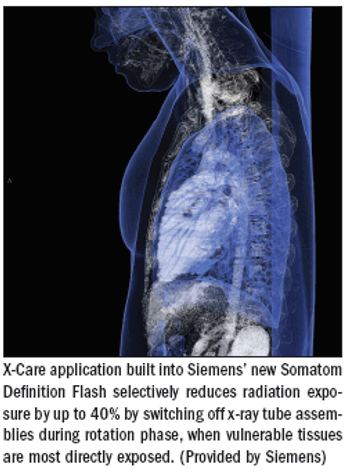
Concerns about CT dose that took root in Europe have emigrated to the U.S. With both sides of the Atlantic involved, vendors have launched an all-out war to reduce patient dose. One of the latest developments is the Definition Flash, which, according to its developer, Siemens, can cut dose for a high-resolution scan of the coronaries to less than the annual accumulated dose from naturally occurring background radiation.
Siemens Healthcare unveiled a breast ultrasound system at RSNA 2008 whose automated exams could help women’s health practitioners achieve the potential of ultrasound as a complement to mammography.
Siemens underscored its commitment to women’s health with its introduction at RSNA 2008 of Espree Pink, a 1.5T scanner dedicated to breast imaging.
Breaking with its past dependence on phosphor-based computed radiography plates, Fujifilm featured a flat-panel digital radiography system at the RSNA 2008 meeting.
Discovery PET/CT 600 debuted at the RSNA meeting, taking a midtier position in GE Healthcare’s family of hybrid devices.
Flat-panel detectors designed to be pulled from one bucky and put into another -- or simply set upright or laid flat on patient tables -- redefined general radiography suites featured on the RSNA exhibit floor this year. They came from suppliers such as Trixell, Varian, and Canon. Some were wireless. Others bore cables with easy disconnects for quick relocation.
An intuitive interface, faster PC server, and work-in-progress detector panel enhance the Infinix VF-i/BP (biplane) Vascular X-ray at the Toshiba America Medical Systems booth at RSNA 2008.
A low-cost 16-slice scanner designed for cost-constrained customers debuted at the Philips booth during the RSNA meeting.