
Feature|Articles|August 21, 2026
From Complexity to Confidence: Reducing Cognitive Load in Modern CT Imaging
In addition to providing stronger image quality, well-designed photon-counting CT systems may facilitate increased standardization, efficiency and simplification that may lead to reduced cognitive burden for radiologists.
Advertisement
Health-care systems today face a difficult paradox. As diagnostic capabilities advance, so does the complexity required to use them effectively. Radiology teams are navigating rising patient volumes, increasingly sophisticated imaging techniques and mounting pressure to deliver faster, more precise answers.
However, more capability shouldn’t mean more cognitive burden for these care teams. The next frontier of innovation isn’t just about what clinicians can see, but rather about how easily they can get there.
Making the Shift from Optimization to Simplification
In computed tomography (CT) imaging, complexity often starts well before image acquisition.
Protocol selection, contrast parameters, spectral imaging settings, and reconstruction parameters all require time, expertise and careful judgment. Variability across technologists, system capability and sites can introduce inconsistencies in image quality and contribute to workflow inefficiencies.
Historically, imaging innovation has focused on optimization via better resolution, more data, and more parameters to fine-tune. With new technologies like photon-counting CT (PCCT), the number of parameters and image types available to choose from has the potential to create a significant new level of complexity if not managed appropriately in the system design.
In comparison to conventional CT systems that convert X-rays into light before measuring them, PCCT directly counts individual X-ray photons and measures their energy, enabling multi-energy spectral information. By counting each individual photon, PCCT facilitates optimal use of the data to potentially unlock capabilities beyond conventional CT. This technology provides enhanced imaging outputs like ultra-high-definition images and valuable spectral images for tissue characterization to help support more timely, confident diagnoses for patients.
When paired with advanced data management tools and a high-performing semiconductor material such as silicon, this technology has the potential to deliver ultra-high definition and spectral capability in a single scan. This is designed to help standardize next-generation imaging protocols even in the most complex patient cases.
This introduces a fundamentally different approach to CT imaging through a one-scan method to reduce exam-specific protocols and enable automated reconstruction of ultra-high-definition spectral images on demand. This approach offers a number of key benefits.
Five Key Benefits with Photon-Counting CT
• Reduced complexity. Capturing comprehensive data in a single scan reduces the need for multiple protocols to choose from, or the need to repeat acquisitions to collect multiple datasets. This helps simplify workflows and minimize upfront decision-making by the technician.
• Deeper clinical insights. In the most complex patient cases, clarity and confidence are critical. The ability to deliver ultra-high-definition detail and deep spectral insights in one scan enables more informed decision-making for even the most challenging cases in both clinical care and research.
• Enabling dose optimization. The technology captures and uses X-ray information more efficiently, helping maintain image quality and contrast while supporting dose optimization.
• Greater consistency across teams. Standardized acquisition reduces variability between operators and sites, supporting more predictable outcomes. By making spectral image types available in every scan mode, it means every patient can receive the same exam independent of size, location, or indication.
• Improved operational efficiency. Simplified workflows help optimize throughput in busy imaging settings.
Why Simplification in Modern CT Imaging Matters Now More Than Ever
The need for simplification is not theoretical. It reflects the realities health-care systems are facing today. Rising demands, staffing shortages and increasing diagnostic complexity are putting pressure on radiology departments to do more with less. At the same time, expectations around speed, consistency and diagnostic confidence continue to rise. Radiology teams are increasingly asked to deliver high-quality insights quickly while minimizing variability and maintaining throughput.
Photon-counting CT technology can and should be designed to help radiology teams navigate these demands and support more efficient and confident clinical decision-making. The future of CT will not be defined solely by sharper images or more data points. It will be defined by technologies that reduce cognitive load, standardize workflows and empower clinicians to focus on what matters most: delivering confident, timely diagnoses.
Chad Rowland is the executive director of global computed tomography at GE HealthCare.
Advertisement
Related to this article

Catch up on the top radiology content of the past week.
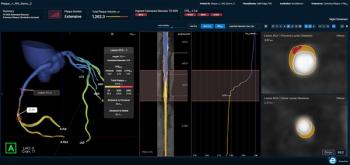
The FFR-IQ software recently demonstrated a 92.2 percent sensitivity for non-invasive estimation of fractional flow reserve (FFRC) based on coronary CT angiography (CCTA) scans.
Catch up on the top radiology content of the past week.
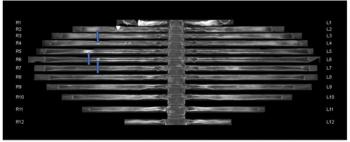
The use of adjunctive CT bone reading software in women with breast cancer detected between 8 to 22 percent more metastatic lesions for reviewing radiologists and reduced CT interpretation time by 50 percent or more, according to a new study.

Does fractional flow reserve (FFR) or quantitative plaque burden from CCTA provide greater prognostic insight into coronary disease?
Catch up on the most-well viewed radiology content in September 2026.

Newly published preclinical research signals a substantial conceptual shift with a potential role of photon-counting CT in targeting specific biological processes.
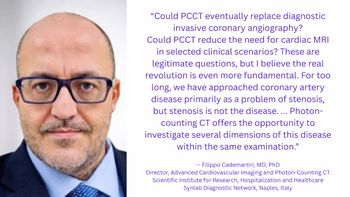
While a new article raises provocative questions about the capability of photon-counting CT (PCCT) to perhaps replace diagnostic ICA, the real revolution with this modality is going beyond stenosis measurement to a renewed focus on the disease of atherosclerosis.
Advertisement
Advertisement
Trending on Diagnostic Imaging
1
FDA Clears MRI-Based AI Software for Prognostic Evaluation of Patients with Mild Cognitive Impairment
2
FDA Clears AI-Enabled FFR-IQ Software for Estimating Fractional Flow Reserve from CCTA
3
How AI, Theranostics and More Empowered Patients Have Led to Significant Changes in Radiology
4
What’s Next for AI in Radiology?: Facilitating Data Orchestration Over Fragmentation
5