

Blog|Articles|October 1, 2026
Raising Questions on the Prognostic Value of Fractional Flow Reserve from CCTA
Author(s)Filippo Cademartiri, MD, PhD
Does fractional flow reserve (FFR) or quantitative plaque burden from CCTA provide greater prognostic insight into coronary disease?
Advertisement
A new Circulation study provides one of the largest real-world evaluations of the prognostic value of fractional flow reserve from computed tomography (FFR-CT).1
In 7,836 patients from 27 centers who were followed for about three years, progressively lower FFR-CT values were associated with increasing risk of myocardial infarction (MI), cardiovascular death and revascularization.1
After adjustment for risk factors and CAD-RADS, stenosis-specific FFR-CT ≤ 0.70 was associated with approximately threefold higher MI risk while the optimal threshold for MI or cardiovascular death was 0.67, substantially lower than the conventional 0.80 ischemic threshold.1
These are interesting findings but there is another question one should consider: How much prognostic information did FFR-CT actually add?
Clinical risk factors alone produced a C-index of 0.758.
Adding anatomical stenosis severity increased it to 0.771.
Adding FFR-CT increased it further to 0.783.
So the incremental improvement attributable to FFR-CT was ΔC-index = 0.012.1
Is this statistically significant? Yes.
Is it transformative prognostic information? Meh. Maybe? That is a very different question.
What is My Take on This Study and FFR-CT?
I firmly believe FFR-CT is going to become an integral part of coronary computed tomography angiography (CCTA) evaluation when needed.
This is a strong study supporting FFR-CT as a marker of prognosis, particularly when values become markedly abnormal.
However, association should not be confused with mechanism.
Lower FFR-CT inevitably reflects, at least partly, the underlying atherosclerotic burden, stenosis severity and diffuse coronary disease.
We should also consider the most important limitation of the study: Plaque burden was not available.
Does FFR-CT Offer Prognostic Value Beyond Quantitative Total Plaque Burden?
The study authors acknowledge that it remains unknown whether FFR-CT provides incremental prognostic value over quantitative total plaque burden.
This distinction matters.
FFR-CT describes the physiological consequence of coronary disease. Plaque imaging measures the disease itself.With quantitative CCTA, AI-based plaque analysis and increasingly photon-counting CT (PCCT), the next comparison should therefore not simply be: “stenosis + FFR-CT” but rather “plaque burden + plaque phenotype + stenosis + physiology.”
Only then will we understand how much independent prognostic information physiology really adds.
Dr. Cademartiri is the director of advanced cardiovascular imaging and photon-counting CT at the Scientific Institute for Research, Hospitalization, and Healthcare Synlab Diagnostic Network in Naples, Italy. He is also a consultant in advanced cardiovascular imaging at CDI/Centro Diagnostico Italiano in Milan, Italy.
(Editor’s note: This blog is adapted with permission from Dr. Cademartiri’s original LinkedIn post available at:
Advertisement
Related to this article
The FFR-IQ software recently demonstrated a 92.2 percent sensitivity for non-invasive estimation of fractional flow reserve (FFRC) based on coronary CT angiography (CCTA) scans.

Catch up on the top radiology content of the past week.
Catch up on the top radiology content of the past week.
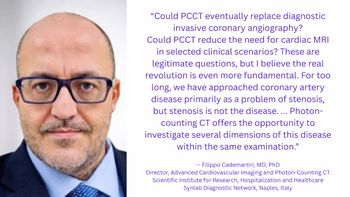
While a new article raises provocative questions about the capability of photon-counting CT (PCCT) to perhaps replace diagnostic ICA, the real revolution with this modality is going beyond stenosis measurement to a renewed focus on the disease of atherosclerosis.
The use of adjunctive CT bone reading software in women with breast cancer detected between 8 to 22 percent more metastatic lesions for reviewing radiologists and reduced CT interpretation time by 50 percent or more, according to a new study.
Catch up on the most-well viewed radiology content in September 2026.

In a new podcast episode, Joseph Cavallo, MD, MBA, offered his perspective on AI integration, potential efficiency gains, navigating post-deployment monitoring and how to incorporate AI literacy into radiology resident training.

How will generative AI software be evaluated by the FDA in the future? What’s next for point-of-care ultrasound? What steps have been successful in facilitating adoption of AI applications across enterprise systems? Leaders in radiology and health care will be discussing these topics and more at the upcoming HLTH USA conference.
Advertisement
Advertisement
Trending on Diagnostic Imaging
1
FDA Clears MRI-Based AI Software for Prognostic Evaluation of Patients with Mild Cognitive Impairment
2
FDA Clears AI-Enabled FFR-IQ Software for Estimating Fractional Flow Reserve from CCTA
3
Can MRI-Based AI Have an Impact in Reducing Unnecessary Prostate Biopsies?
4
Can the Kaiser Score with Breast MRI Improve Clarity for BI-RADS 0 and 4 Assessments on Mammography and Ultrasound?
5