“To our knowledge, this is the first attempt to use ultrasound-based intratumoral and peritumoral (radiomic signatures). … Our developed models can offer a noninvasive approach to assessing HER2 levels in diverse individuals with breast malignancies and serve as a valuable tool to aid clinicians in making more precise and personalized decisions,” wrote lead study author Siwei Luo, M.D., who is affiliated with the Department of Ultrasound at Guangdong Provincial People’s Hospital in Guangzhou, China, and colleagues.
The study authors noted the zone entropy feature was particularly germane to differentiating between HER-2-positive, -low and -zero subtypes.
“A higher ZE value indicated a more heterogeneous voxel intensity in the ultrasound images and showed a positive impact on the predicted probability of a HER2-positive status, which is in agreement with previous studies,” pointed out Luo and colleagues.
Three Key Takeaways
1. Enhanced accuracy in HER2 differentiation. The combined clinical radiomics model, integrating ultrasound-based radiomic tumor and peritumoral features with clinical factors, significantly improved discrimination of HER2 breast cancer subtypes, achieving an 86.2 percent AUC and 72.7 percent accuracy, outperforming radiomics-alone and clinical models.
2. Radiomic feature insights. The zone entropy (ZE) feature was particularly useful for distinguishing HER2 subtypes, with higher ZE values indicating greater voxel intensity heterogeneity in ultrasound images and a positive correlation with HER2-positive status.
3. Role of calcifications. Calcifications were strongly associated with HER2-positive cases, with an 85.2 percent prevalence in the largest study cohort, reinforcing their significance in predicting HER2 status and aligning with prior research findings.
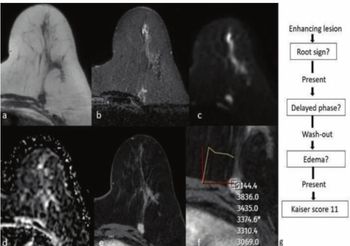
The researchers also said that calcifications consistently had the highest prevalence in HER-2 positive cases across the three participating centers in the study, accounting for 85.2 percent of HER-2 positive cases in the largest center cohort of 940 patients.
“Our results demonstrated that calcifications play a major positive role in predicting HER2-positive status and a negative role in predicting HER2-zero status, which is consistent with previous studies showing that calcification is more common in HER2-positive tumors and increases with HER2 (immunohistochemistry) score,” added Luo and colleagues.
(Editor’s note: For related content, see “Can Radiomics and Autoencoders Enhance Real-Time Ultrasound Detection of Breast Cancer?,” “What a New Study Reveals About Whole-Breast Ultrasound Tomography, Mammography and Dense Breasts” and “Breast Ultrasound Study: AI Radiomics Model May Help Predict Lymphovascular Invasion in Breast Cancer Cases.”)
Beyond the inherent limitations of a retrospective study, researchers conceded the variety of ultrasound devices and parameters settings may have had an impact on the study results. Pointing out the use of manual segmentation for intratumoral regions of interest by two radiologists with 10 years of experience, the researchers emphasized the time-consuming aspect of this approach, which may be subject to variability due to different experience levels.