



CT
Latest News
Advertisement
Latest Videos














Advertisement
More News
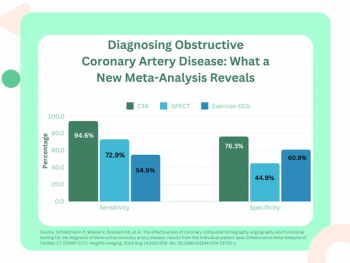
For patients with stable chest pain, CT angiography demonstrated a nearly 40 percent higher sensitivity rate than exercise electrocardiography and over an 18 percent higher sensitivity rate than SPECT for detecting obstructive coronary artery disease (CAD).
Catch up on the top radiology content of the past week.
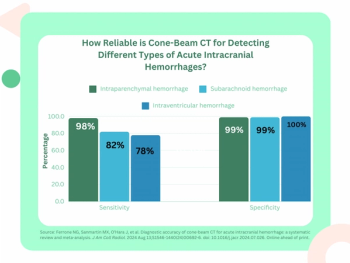
While cone-beam computed tomography (CBCT) demonstrated high pooled sensitivity and specificity rates for intraparenchymal hemorrhage in the systematic review, researchers noted higher false-negative rates for subarachnoid and intraventricular hemorrhages.
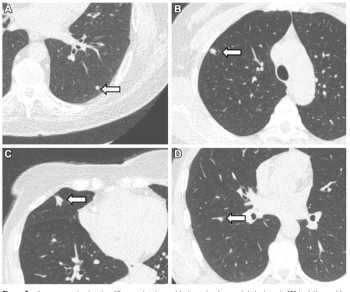
Utilizing low-dose computed tomography (CT) scans for a cohort of over 10,000 non-smokers, researchers found that over 11 percent of study participants had clinically relevant lung nodules.

Review the case and test your knowledge to make the correct diagnosis.
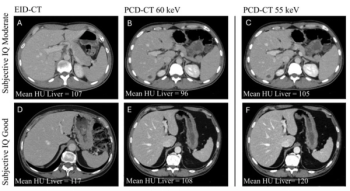
In addition to a 20.1 percent reduction in iodine load, photon-counting CT offered higher signal-to-noise and contrast-to-noise ratios than energy-integrating detector CT in a new study.
Catch up on the top radiology content of the past week.
Automated CT-derived assessments may provide stronger stratification of diabetes and cardiometabolic risks than conventional predictive models, according to a new study of over 32,000 adults in Korea.
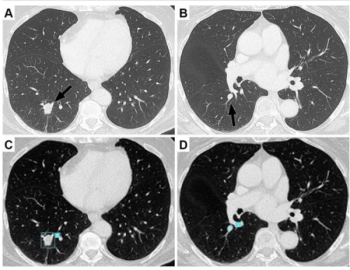
New research shows the use of adjunctive AI resulted in a 12 percent higher sensitivity rate for lung nodule detection in comparison to radiologists without AI.
Catch up on the top radiology content of the past week.
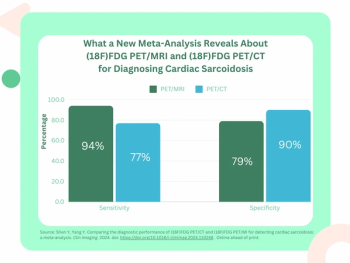
The researchers found that (18F)FDG PET/MRI had a 17 percent higher pooled sensitivity rate for cardiac sarcoidosis in contrast to (18F)FDG PET/CT.
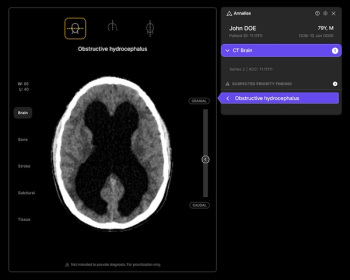
The first radiology triage modality to garner a Breakthrough Device Designation from the FDA, Annalise-Obstructive Hydrocephalus has reported sensitivity and specificity rates of 97.5 percent and 95.3 percent respectively.
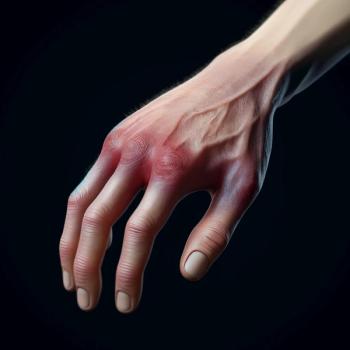
While contrast media extravasation is a rare complication, there can be varying degrees of severity. Accordingly, this author reviews possible causes of this complication, prevention principles and pertinent considerations in addressing this complication when it does occur.
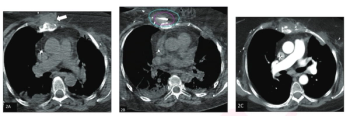
In a study involving 217 percutaneous cryoablation procedures for treating recurrent or metastatic soft tissue sarcoma in 141 patients, researchers noted an 86 percent rate of local progression-free survival and a 2 percent complication rate.
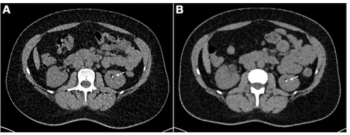
New research shows that photon-counting computed tomography (PCCT) at an effective dose of 0.79 mSv provided significantly higher signal-to-noise ratios for urinary calculi (kidney stone) detection than energy-integrating detector CT at 1.39 mSv.
Review the case and test your knowledge to make the correct diagnosis.
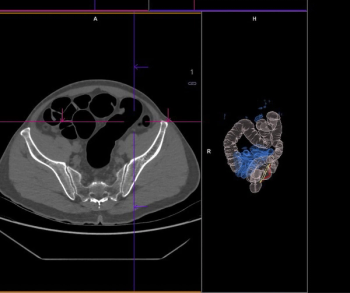
In a 10-year analysis of computed tomography colonography (CTC) use in the United States, researchers found that CTC use increased from 1.4 percent of adults in 2019 to 3.5 percent in 2021.
Catch up on the most-well viewed radiology content in July 2024.
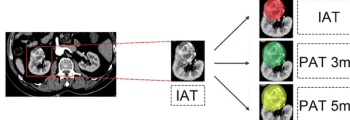
An emerging diagnostic model incorporating radiomic features from intratumoral and peritumoral regions exhibited a 29 percent higher AUC and 77 percent higher sensitivity rate than a clinical model for predicting the grading of clear cell renal cell carcinoma, according to recent research.
Catch up on the top radiology content of the past week.
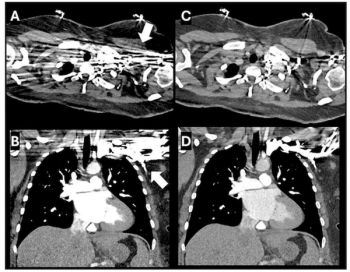
New research looking at photon-counting computed tomography (PCCT) demonstrated significantly reduced variation and tracheal air density attenuation with polyenergetic reconstruction in contrast to monoenergetic reconstruction on chest CT.
Catch up on the top radiology content of the past week.
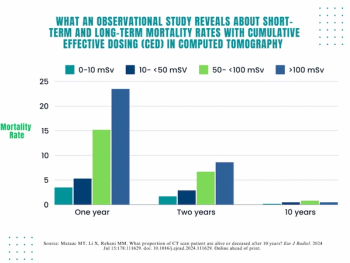
Emerging research suggests CT radiation dosing of 50 mSv or greater is associated with higher mortality at two years but nearly half of those patients were alive 10 years later.
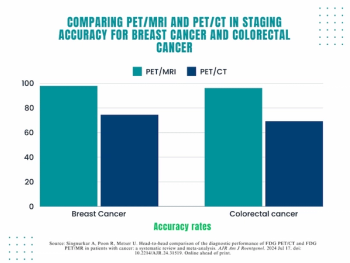
While PET/MRI and PET/CT had comparable sensitivity for patient-level regional nodal metastases and lesion-level recurrence, the authors of a systematic review noted that PET/MRI had significantly higher accuracy in breast cancer and colorectal cancer staging.
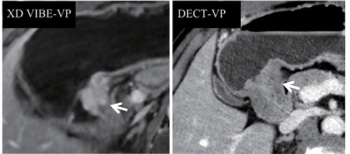
Researchers found that mpMRI was 18 percent more accurate than dual-energy CT (DECT) for T1 staging and 19 percent more accurate for N3 staging of gastric cancer.
Advertisement
Advertisement
Trending on Diagnostic Imaging
1
Radiology and Building the Alzheimer’s Care Pathway of the Future
2
FDA Grants Fast Track Designation for Pre-Biopsy Use of PSMA PET and MRI for Prostate Cancer Detection
3
Current Perspectives on Integrating AI into Radiology
4
The Reading Room Podcast: Current Perspectives, Challenges and Possibilities with AI in Breast Imaging, Part 1
5