



Facility Management
Latest News

December 19th 2023
By Jeff Hall
In addition to offering a 98.5 percent sensitivity rate in diagnosing fractures on X-ray, an emerging artificial intelligence (AI) software reportedly helped reduce mean turnaround time on X-ray fracture diagnosis from 48 hours to 8.3 hours, according to new research presented at the Radiological Society of North America (RSNA) conference.
Advertisement
Latest Videos




CME Content




Advertisement
More News
Reimbursement for use of the artificial intelligence (AI)-powered EchoGo Heart Failure platform in hospital outpatient settings for Medicare and Medicaid patients is expected to increase from $99.81 to $284.88 in 2024.
The ability to consider and comment on prior imaging in the radiology report may help reduce extraneous addenda requests.
Catch up on the top radiology content of the past week.
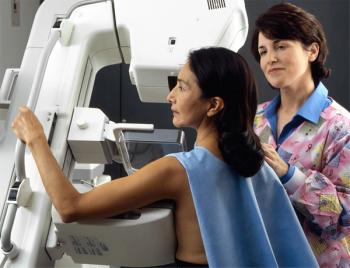
Incorporating text messaging into your mammography screening program may facilitate improved mammography screening rates in your patient population as well as enhanced practice management efficiencies.

The executive order seeks to promote continued innovation and growth with artificial intelligence (AI) while ensuring monitoring of AI models for safety, privacy, and equity.
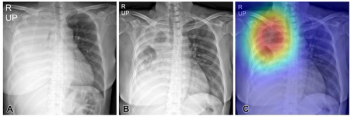
An emerging deep learning algorithm can reportedly triage 40 percent of no-change X-rays while providing 88 to 90 percent accuracy for detecting changes with X-rays obtained in the emergency department and intensive care unit at a tertiary referral hospital, according to recently published research.
Catch up on the top radiology content of the past week.
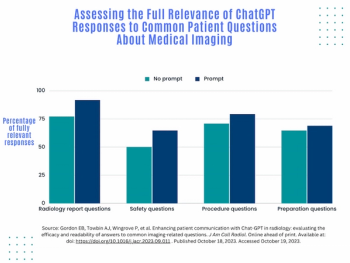
While ChatGPT has the potential to help streamline responses to imaging-related questions from patients, the authors of a new study found that a third of ChatGPT responses to unprompted questions on medical imaging were not “fully relevant.”
The success of compliance initiatives is often preceded by an easily understood rationale and simply stated benefits.
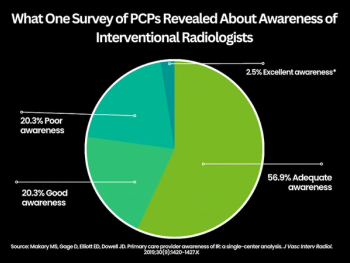
While interventional radiologists can have an impact in a number of clinical areas by offering minimally invasive options for patients, there remains a prevailing lack of awareness about the speciality among referring physicians and patients. Accordingly, these authors delve into the issue and discuss an array of options for elevating awareness of interventional radiology.
By leveraging subtle signals on routine X-rays to assess bone mineral density (BMD), the technology may facilitate earlier detection of osteoporosis and help prevent fragility fractures.
The Rology teleradiology platform may improve access to top tier-imaging interpretation for stand-alone imaging centers, rural facilities and low-income patients.
Catch up on the top radiology news of the past week.
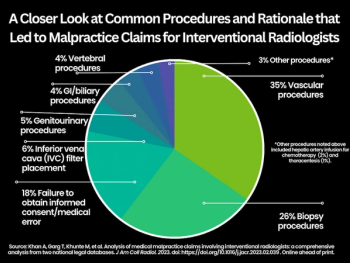
Thirty-five percent of the interventional radiology malpractice cases involved vascular procedures and 26 percent of overall malpractice cases that went to trial resulted in plaintiff judgments with the average award being over $2 million.

Does access to prior imaging results have to be mission impossible for teleradiologists?

The controversial Independent Dispute Resolution (IDR) process of the No Surprises Act was temporarily suspended by the CMS on August 4 due to a federal court ruling that vacated a substantial administrative fee increase and batching rule from the CMS that reportedly curtailed challenges of claim reimbursement by radiologists and other providers.

Addressing ancillary repetitious inhibitors to radiology workflow could go a long way to mitigating burnout risk.

Recognizing the advent of beta amyloid-targeted therapies for the treatment of Alzheimer’s disease, the Centers for Medicare and Medicaid (CMS) has proposed eliminating coverage restrictions that limit amyloid positron emission tomography (PET) scans to clinical trial participants and one amyloid PET scan per lifetime.
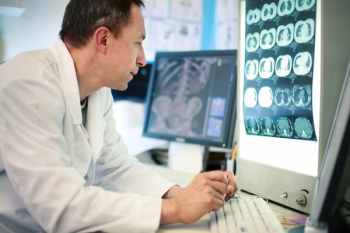
The notion of non-physician practitioners (NPPs) attempting to do radiologist-level work is a very slippery slope and what this author refers to as the “bargaining” stage of grief.
Catch up on the top radiology content of the past week.
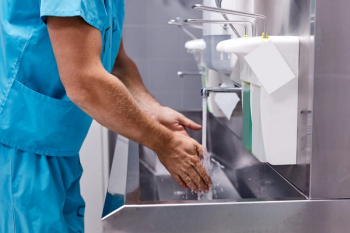
Noting recent double-digit increases in health-care associated infections (HAIs) and potential vulnerabilities in radiology departments, this author emphasizes proactive preventive measures to protect patients and staff.
Catch up on the top radiology content of the past week.
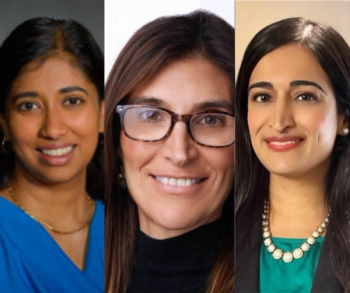
In recent video interviews, Tessa Cook, MD, PhD, Nina Kottler, MD, MS, and Sonia Gupta, MD shared their insights and perspective on potential benefits and drawbacks of ChatGPT in radiology.
In a recent video interview, Wendie Berg, M.D., Ph.D., discussed the newly issued final rule from the Food and Drug Administration (FDA) requiring a national standard for breast density notification (starting on September 10, 2024) as well as its potential impact in mammography reporting and facilitating supplemental screening for patients with dense breasts.
In a recent video interview, Sonia Gupta, MD discussed a number of ongoing developments with artificial intelligence (AI) in radiology, ranging from market consolidation of AI vendors to maximizing automation and efficiency with patient triage, reporting and follow-up of incidental findings.
Advertisement
Advertisement
Trending on Diagnostic Imaging
1
Key Features with EPNI on CT May More than Double Mortality Risk in Pancreatic Cancer
2
Is Late Arterial Phase CT Necessary for Undifferentiated Acute Abdominal Pain?
3
Could a CCTA-Guided Approach Provide a Viable Alternative to Intravascular Ultrasound Guidance for PCI Procedures?
4
Interventional Radiology in Focus: Emerging Concepts with Ablation and Histotripsy in Interventional Oncology
5