

Looking for a practical meeting where you can apply what you've learned to everyday practice?
Looking for a practical meeting where you can apply what you've learned to everyday practice?
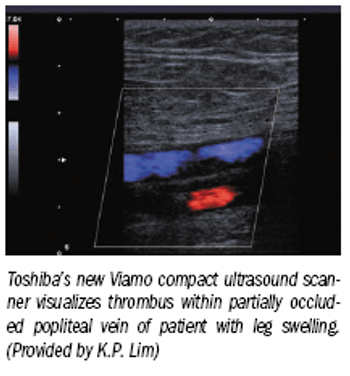
Philips and Toshiba have joined ultrasound vendors looking to cash in on physicians' love of good things that come in small packages.
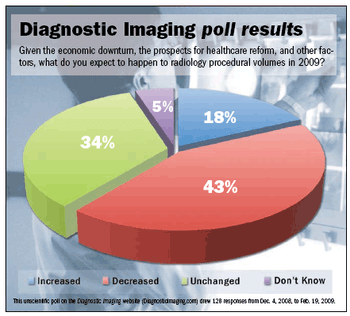
Despite progress on several fronts, the SNM Clinical Trials Network has received a cool response from recession-shocked pharmaceutical companies whose participation and financial support are considered crucial to the program's success.
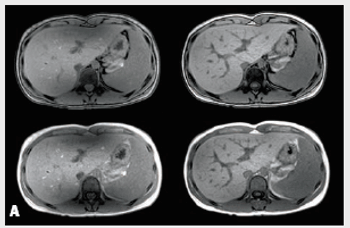
Image quality derived from echo liver imaging at 3T (A, left) improves (A, right) when applying Philips MultiTransmit technology, which eliminatesdielectric shading, an artifact commonly found at this field strength.


Other headlines: Ziosoft signs European distributorMITA unloads on Medicare ProSolv plans to debut enhances CV PACSSony releases medical printer
Other headlines:Varian unveils interventional angio detectorVI goes down underFDA moves to assess iCAD virtual colonography
Two radically different opinions have emerged to describe why the Centers for Medicare and Medicaid Services decided not to extend Medicare coverage to CT colonography screening. One credits a new policy requiring efficacy data that considers the effect of proposed medical applications specifically on a Medicare population. The other cites the influence of the U.S. Preventive Services Task Force.

Intravenous iodinated contrast agents are generally safe. Though the frequency of side effects has fallen significantly since the introduction of nonionic, monomeric contrast agents,1 however, side effects remain an important issue.
Other headlines:Sectra grows despite economic downturn
Other headlines:PACSGear preps disk writer for SIIM
Software that improves image quality is on track to be a champion of CT dose reduction now and in the future.
Other headlines:Brit readies PACS launch for SIIM
A lifesaver for some and source of wasted diagnostic effort for others, incidental findings from CT colonography present opportunities and risks for patients and imaging practitioners.
The floodgates of advanced processing sprang wide Wednesday, unleashing a three-hour torrent of 2D and 3D renderings from eight workstations in what has become an annual event at the International Symposium on Multidetector-Row CT.
Systems that effectively archive today’s thin-slice CT images are the wave of the future, but they aren’t here yet. In the meantime, PACS administrators need to be aware of this trend and consider scalable solutions that keep their options open for future developments, according to a presentation at the 2009 International Symposium on Multidetector-Row CT.
When it comes to iodinated contrast reactions in children, it’s important to have a policy in place before the need arises, as well as appropriate training, equipment, and physiologic ranges, according to a presentation by Dr. Donald P. Frush at the International Symposium on Multidetector-Row CT May 19.
Like Goldilocks testing the bears’ porridge, the American College of Radiology and other professional societies are using diagnostic reference level (DRL) data to tell radiologists if the patient dose radiation from their CT scanners is too hot or just right.
Other headlines: Cardiac cath usage declinesViztek launches mammo PACS viewer
Chinese Hospital is dedicated to serving patients of Chinese descent in San Francisco. By integrating advanced processing techniques and scheduling, its Carestream RIS/PACS helps the hospital make the most of its resources. Greg Freiherr has the story from San Francisco’s Chinatown.
The new generation of wide CT detectors provides expanded coverage, allowing faster scans and even dynamic imaging of organs, including heart and brain. There are disadvantages, said Dr. Mathias Prokop, speaking May 19 at the 11th International Symposium on Multidetector Row CT, but these are minor in comparison.
A smorgasbord of challenges face radiology but few present a greater threat than the “invisible radiologist,” said Dr. Gary Glazer, chairman of the Stanford University radiology department, who kicked off the 11th International Symposium on Multidetector-Row CT.
Other headlines: Volcano enter thrombus aspiration nicheFonar writes bottom line in black
The Access to Medical Imaging Coalition has introduced an attractive new website designed to inform the public about the clinical capabilities and political controversies that surround diagnostic imaging practice.
As researchers and clinicians gather to discuss the latest developments in advanced CT imaging, it is ironic that the new capabilities on exhibit here could become more affordable than ever for those in a position to acquire them.
Other headlines:IMV study raises hope of 2009 reboundLightLab unveils OCT product

Technical innovations that were first rolled out at the 2008 RSNA six months ago will be reintroduced to the medical imaging community driving improved clinical applications highlighted at the 2009 International Symposium on Multidetector-Row CT May 19 to 22.
Despite a dismal start to 2009, most U.S. hospital radiology administrators expect restrictions against capital acquisitions to ease, giving them a chance to address their most pressing needs and acquire diagnostic imaging equipment later this year.
Other headlines:ACR Image Metrix plans to support PET/CT Bone trial
Bucking the tide of medical professional opinion, the Centers for Medicare and Medicaid Services has decided against granting payment for CT colonography as a screening test for colorectal cancer. CMS ruled Tuesday that the clinical evidence remains inadequate to conclude that CTC is appropriate for that role.