
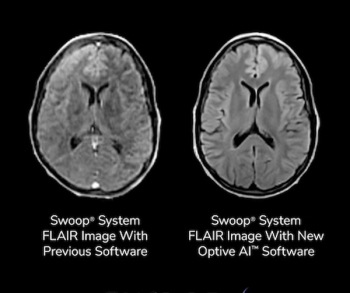
The Optive AI software, the tenth software release for the Swoop portable MRI system, reportedly offers enhanced clarity and anatomical detail for ultra-low-field MRI of the brain.
The Optive AI software, the tenth software release for the Swoop portable MRI system, reportedly offers enhanced clarity and anatomical detail for ultra-low-field MRI of the brain.
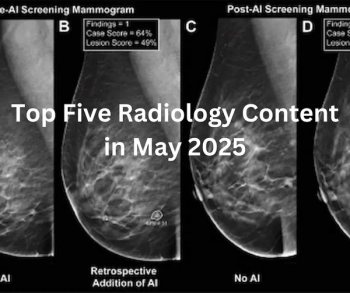
Catch up on the most-well viewed radiology content in May 2025.
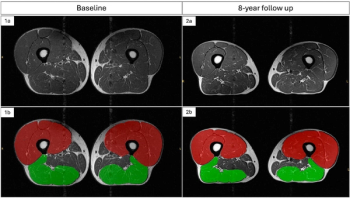
For overweight and obese patients at risk for knee osteoarthritis (OA), eight-year follow-up MRI data revealed a 12.8 percent loss of thigh muscle sub-volume for people who had extensive weight loss in comparison to 5.1 percent for those who retained a stable weight.
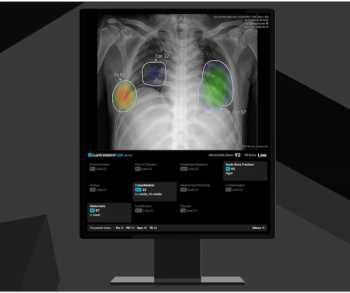
The Lunit Insight CXR4 update reportedly offers new features such as current-prior comparison of chest X-rays (CXRs), acute bone fracture detection and a 99.5 percent negative predictive value (NPV) for identifying normal CXRs.
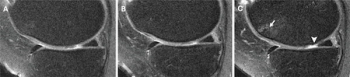
Two years after intraarticular knee injections for knee osteoarthritis (OA), study participants who had corticosteroid knee injections had greater OA progression than control patients while the use of hyaluronic acid injections was associated with less OA progression.
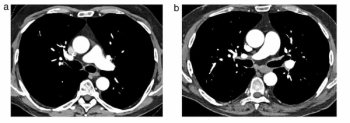
In a review of 155 studies, researchers examined the capabilities of photon-counting computed tomography (PCCT) for enhanced accuracy, tissue characterization, artifact reduction and reduced radiation dosing across thoracic, abdominal, and cardiothoracic imaging applications.
What are the key considerations to ensuring an optimal pace at your workstation?

Catch up on the top AI-related news and research in radiology over the past month.
Catch up on the top radiology content of the past week.
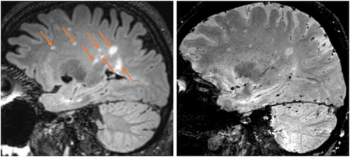
Recognition of the central vein sign with a six-minute MRI demonstrated comparable sensitivity for multiple sclerosis (MS) detection in comparison to oligoclonal band (OCB) assessment, which requires lumbar puncture, according to newly published research.
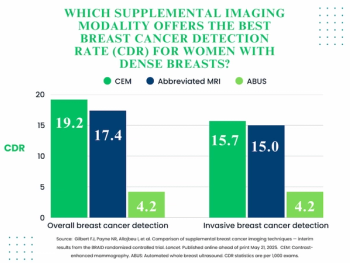
For women with dense breasts and negative mammograms, contrast-enhanced mammography and abbreviated MRI provided respective cancer detection rates of 19.2 per 1000 exams and 17.4 per 1000 exams, according to new research.
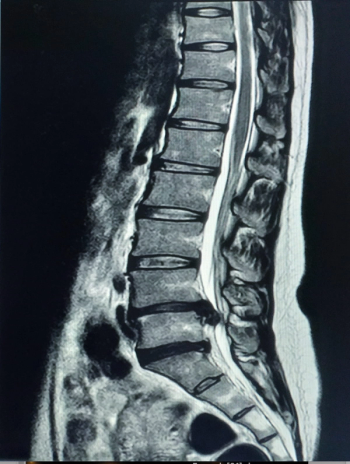
The MSKai software provides AI-powered segmentation, labeling, and measurement tools for assessment of T2-weighted MRIs of the lumbar spine.
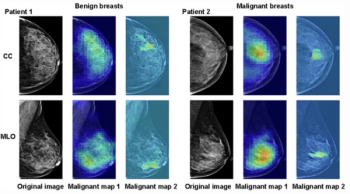
In a study involving over 12,000 Asian women, researchers found that an artificial intelligence (AI) model converted over 83 percent of false positives in patients with initial BI-RADS 3 and 4 assessments into benign BI-RADS categories.
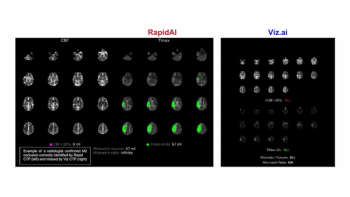
The Rapid CTP AI software offered 23 percent greater detection of medium vessel occlusions in comparison to the Viz CTP AI software, according to research presented at the European Stroke (Organization) Conference (ESOC).
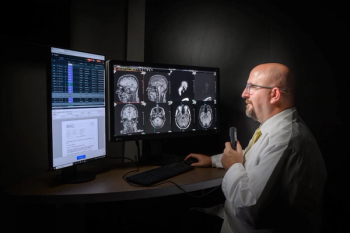
The cloud-based platform reportedly facilitates AI-enhanced teleradiology workflow efficiencies across multiple systems and facilities.
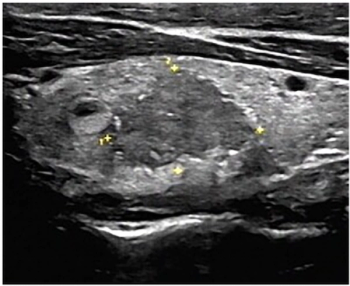
Incorporating six independent predictive factors for malignant thyroid nodules with peripheral calcifications, an emerging ultrasound-based nomogram provided an 88.2 percent AUC in validation testing.
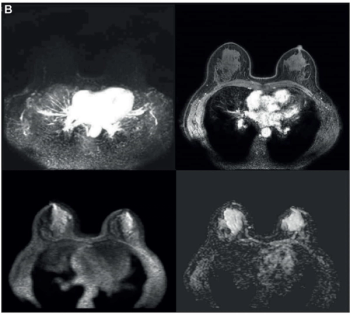
Emerging research suggests that abbreviated breast MRI offers comparable sensitivity and specificity as multiparametric MRI in women with extremely dense breasts with a nearly 50 percent reduction in reading time for radiologists.
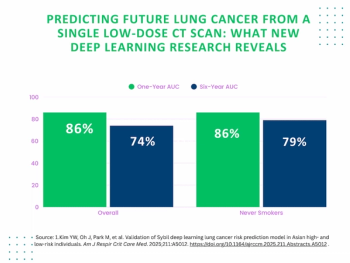
In never-smokers, deep learning assessment of single baseline low-dose computed tomography (CT) scans demonstrated a 79 percent AUC for predicting lung cancer up to six years later, according to new research presented today at the American Thoracic Society (ATS) 2025 International Conference.
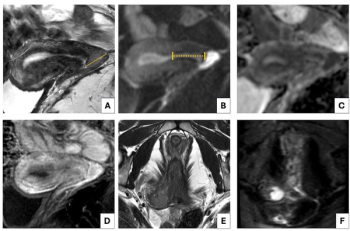
New guidelines from the European Society of Urogenital Radiology (ESUR) offer pertinent principles and recommendations for MRI use in considering fertility-sparing treatments for women with ovarian, endometrial, or cervical cancer.
Whether it is reimbursement cuts or continued attempts to push non-radiologist image interpretation, where do we draw the line between inspired protest and misspent energy criticizing things that are doomed to fail or things we have no control over?
Catch up on the top radiology content of the past week.
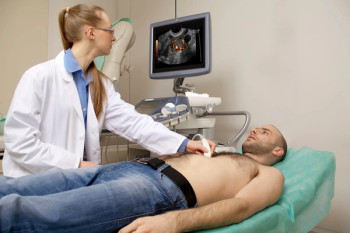
Those receiving ultrasound enhancing agents (UEAs) for transthoracic or stress echocardiography had lower odds of all-cause death in comparison to patients who did not have UEAs, according to a nationwide study involving 11.4 million patients.
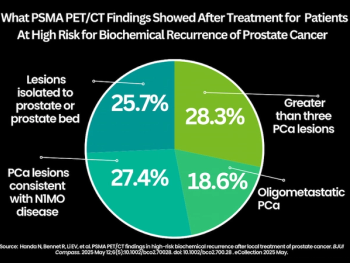
For patients at high-risk for biochemical recurrence of prostate cancer, PSMA PET/CT findings revealed that 77 percent had one or more prostate lesions after undergoing local radiation therapy or radical prostatectomy, according to a recent study.
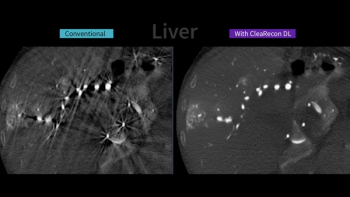
The CleaRecon DL software reportedly removes streak artifacts that can occur with the use of cone-beam computed tomography (CBCT) during interventional radiology procedures.

In a recent interview, C. Alberto Morales, M.D., discussed the impact of advances with CTA imaging and AI, and a shifting emphasis in cardiac risk stratification from stenosis to plaque burden.
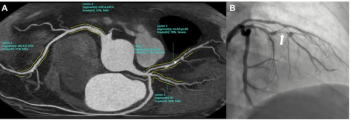
In a study involving over 1,000 patients who had coronary computed tomography angiography (CCTA) exams, AI software demonstrated a 90 percent AUC for assessments of cases > CAD-RADS 3 and 4A and had a 98 percent NPV for obstructive coronary artery disease.
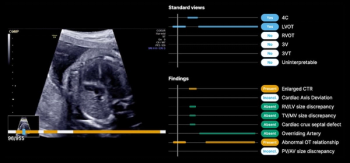
The latest FDA 510(k) clearance is for B-Right Views, an AI-enabled device, which provides automated detection of required views necessary for second- and third-trimester fetal heart ultrasound exams.
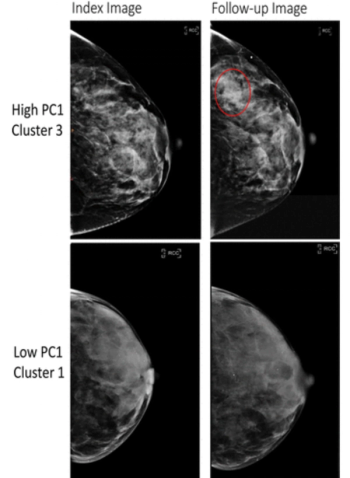
Emerging research suggests that radiomic breast texture features extracted from full-field digital mammography may bolster prognostic assessments of invasive breast cancer risk beyond traditional risk factors.

The only ultrasound enhancing agent that does not contain polyethylene glycol, Optison may now be utilized to enhance echocardiogram assessment of ventricular function in pediatric patients.
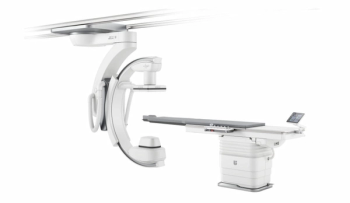
Employing intelligent robotics and enhanced low-dose image quality, the uAngio AVIVA X-ray system also offers hands-free image review and movement.