
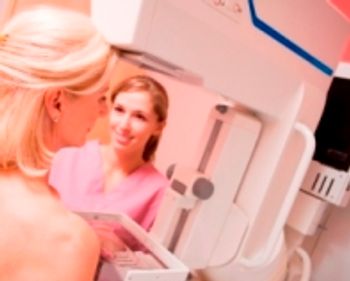
The tides are turning for breast imagers. After several years of declining demand and facility closures, the market is rebounding and more growth is expected.
The tides are turning for breast imagers. After several years of declining demand and facility closures, the market is rebounding and more growth is expected.

Healthcare providers who use cloud computing feel safe with the practice, giving cloud computing a satisfaction score of 4.5 out of 5, according to KLAS.
The man meets machine era is here, and harnessing the power of the machine-man interaction will be key to effective implementation of CAD. So get ready.
Philips received FDA 510(k) clearance for MicroDose SI, a full-field digital mammography system that enables future Single-Shot Spectral Imaging applications.
Breast density can be accurately scored with images obtained through either digital mammography or film-screen mammography.
The notion of a physician as genuine leader of a healthcare team has fallen into disrepute. And it's handy to have someone to blame.
PET/CT for cancer screening in healthy patients? Think twice on this and other nuclear medicine and molecular imaging tests, say SNMMI’s Choosing Wisely list.

As radiologists, we are experts at finding things. Nothing gets by the skilled radiologists!
The Harvey L. Neiman Health Policy Institute’s new report introduces a classification system that could help determine whether a repeat image is necessary.
Mammograms every two years are just as beneficial to women over 65 as are annual exams - and may reduce false positives.
Risks of radiation-induced cancer from CT scans in early adulthood are outweighed by the benefits obtained from the scans.
A rule aid comprising seven factors may aid physicians in deciding whether to refer children for abdominal CT scans following blunt trauma to the abdomen.
Radiation exposure from CCTAs has been significantly reduced with use of a new second-generation CT scanner, without compromising diagnostic accuracy.
Radiology professionals must be properly trained on the risks of contrast agents - and the best way to communicate that to patients. Here’s some guidance.
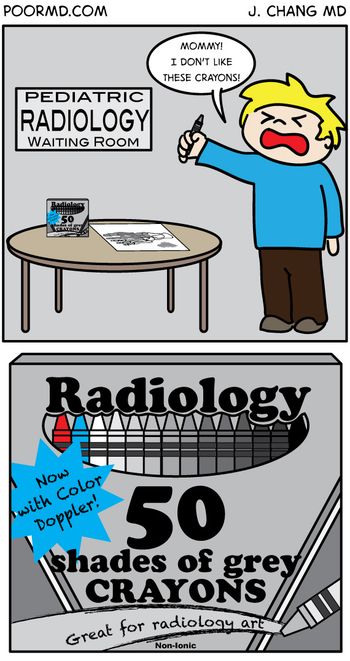
50 Shades of Grey (Radiology Style)
The American Medical Isotope Production Act was signed and CMS added payments for non-highly enriched uranium isotopes. Here’s what it all means for imaging.
Radiologists used certain contrast agents despite a lack of reimbursement, impacting CT adoption. Here’s what that means for emerging technologies and health policy.

An ongoing shortage of barium products is affecting some radiology departments and imaging centers across the country.
Low global barium availability prevents suppliers from filling orders; pushes radiologists to consider CT scan alternatives or use barium substitutes.
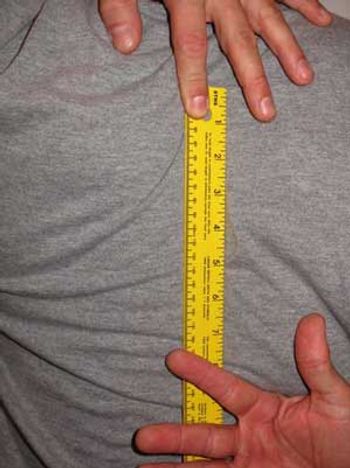
Ultrasound diagnoses tendon tear in 36-year-old male weight-lifter with dull-achy sensation in right shoulder. No trauma or previous injury reported.

Vendors are debuting a next generation of patient portals that may reduce costs, increase patient satisfaction and eliminate duplicate imaging.
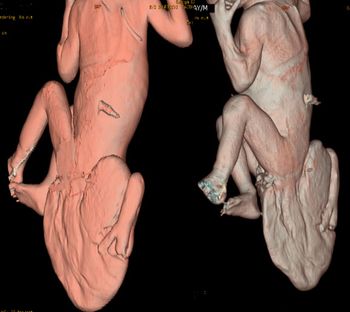
A 2-day-old neonate presented to pediatric emergency with gross congenital anomaly.
Early breast tomosynthesis adopter Washington Radiology Associates increased cancer detection by one-third, decreased call-backs, and improved provider confidence.
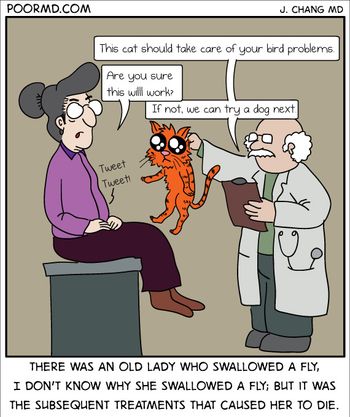
There was an old lady...
The radiology industry will turn to advancements in software this year to improve patient flow, share images, and boost efficiency.
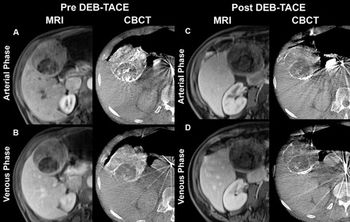
Pairs of specialized CT scans allow researchers to see liver tumors death right after chemo to quickly determine the efficacy of chemoembolization.
2013 will be a big year for informatics, helping radiologists collaborate and consult with referring physicians and increase productivity.

Pari Pandharipande, MD, explores the importance of considering the timing of when a patient experiences a disease and incurs radiation-induced cancer risks.

Stacy Johnson, of Presbyterian Intercommunity Hospital, discusses the use of technology to meet California’s dose reporting requirement and the law’s impact.
The ABR will offer a dual primary certificate in interventional and diagnostic radiology, representing a shift in expertise, the ABMS announced.