

California practices will be required to report CT dose starting July 1, and some are already seeing a culture change when it comes to radiation dose levels.
The use of surgical biopsy is "substantially less than the 30 percent previously alleged," researchers found.
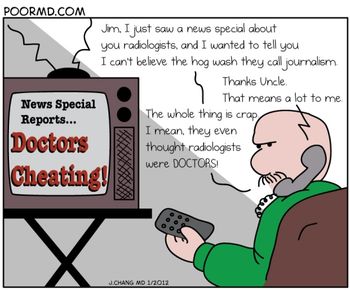
James Chang, MD's latest comic takes on the recent news investigation into radiologists' use of recalls for board exam prep.

Pamela Woodard, MD, of the Mallinckrodt Institute of Radiology at Washington University School of Medicine in St. Louis, discusses the challenges and benefits of being an early adopter of this technology.
Diagnostic Imaging recently spoke with Dr. Rahul Desia, director of interventional pain management at EPIC Imaging, about their experiences with a mobile anesthesia unit.
If those of us who are in positions to evaluate and review hiring policies do not take a significant role in ensuring a level playing field then we are truly to blame.

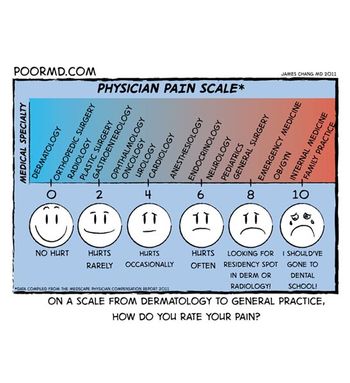
Check out James Chang, MD's latest comic.
Researchers report on a program aimed at minimizing radiation-induced skin injuries.

Check out James Chang, MD's latest comic.
Endovascular lower-extremity revascularization procedures performed by interventional radiologists bring about less transfusion and intensive-care unit use, shorter hospital stays, fewer repeat revascularization procedures, fewer amputations, and lower costs compared to those done by vascular surgeons.
University of Pennsylvania researchers have developed an experimental MRI contrast agent capable of targeting tumors, according to a report in the journal ACS Nano. Its coating, instead of targeting particular cancer receptors - which can be hit-or-miss and depend on the cancer - is attracted to the acidic environments in which tumors generally thrive.
Deciding on next steps in radiology training can be difficult and confusing. To help students, residents, and fellows in the decision-making process, here are a few resources.
CHICAGO - Richard Morin, co-chair of the ACR Dose Index Registry Committee, interviewed at RSNA 2011, explains how radiologists can compare their dose practices with others, to give the metrics more meaning.
CHICAGO - In this interview, the CMIO at Southwest Diagnostic Imaging discusses the process his practice followed to qualify for meaningful use, where they stand now, and whether the work has been worth it.
Over the past 20 years, not only has clinical instruction during radiology residency changed, but so has the practice life that comes after it. Even as a growing number of medical students select radiology as a specialty, practice-setting preferences have shifted for your younger colleagues. They also have a different set of priorities to consider.
CHICAGO - Arl Van Moore, Jr., MD, in an interview at RSNA 2011, discusses what it takes to be successful in radiology.
CHICAGO - There’s too much misinformation circling about meaningful use, said Khan Siddiqui, speaking at RSNA 2011.
CHICAGO - Low-dose remained a top concern at RSNA 2011. James Brink, MD, co-chair of the Image Wisely Joint Task Force, announced that over 10,000 have taken the Image Wisely pledge. The effort to raise awareness asks radiologists to optimize the use of radiation when imaging patients.
CHICAGO - Correct that. Tips. A few simple tricks can make one’s time with computer-based speech-to-text engines much more pleasant - and productive, said David Weiss, MD, speaking during an RSNA 2011 session on practical informatics for radiologists.
CHICAGO - Radiology is still a great career, but students need to learn more about the opportunities and realities.
CHICAGO - You can't improve what you don't measure, says Paul Chang in this video clip from RSNA 2011. He thinks radiology practices should follow other businesses and adopt business analytics and key perfromance indicators. How else can you tell if you are adding quality and improving processes?
CHICAGO - Cynthia Sherry, MD, chair of the Department of Radiology at Texas Health Dallas Presbyterian Hospital discusses the relationship between radiology practices and hospitals.
CHICAGO - To be successful amid declining reimbursement and healthcare reform, radiology residents - and perhaps all practicing radiologists - must do more than perfect their study interpretation skills. Pressures from the industry will require them to do what Bibb Allen, MD, FACR, vice chair of the ACR Commission on Economics, calls “no-pay work.”
CHICAGO-First the good news: 90 percent of radiology practices indeed can qualify for some of the $20 billion in federal stimulus funding set aside to stoke the “meaningful use” of health information technology. What’s more, meaningful use seems to change little the day-to-day work of radiologists, according to those whose practices have been through the meaningful-use wringer.The bad news: getting to “meaningful” takes a whole lot of hard thinking, investment, and work, according to those with experience in the process speaking at RSNA 2011 on Tuesday.
Although a vast majority of radiologists qualify under the federal government’s meaningful use incentive program for electronic health records, many have lingering concerns about the program, according to a new KLAS and RSNA survey.
Whether you’ve embraced voice recognition software or rely on a transcriptionist, there’s still the problem of large amounts of text that’s largely unusable. Enter natural language processing, which makes structured reporting and data mining possible by coding the text and extracting data.
Several months ago, we were considering our eligibility to participate in the federal government’s electronic health record (EHR) incentive program that pays cash incentives to eligible healthcare professionals who make “meaningful use” of certified EHR systems. I mentioned some of our considerations at that time. Now it’s time to look a little closer at some of the details in enrolling.
Medicare spending on medical imaging continues to decline and that Medicare patients are receiving fewer imaging procedures, according to a new analysis of Medicare data released Nov. 17 by the Medical Imaging & Technology Alliance (MITA).
Sectra’s vice president of research and development expects lots of conversations about meaningful use, practice consolidation, and teleradiology.