
Advanced imaging provides good value, say primary care physicians, but how valuable varies by the PCP’s number of years in practice.
Advanced imaging provides good value, say primary care physicians, but how valuable varies by the PCP’s number of years in practice.
Women who have E3 and E4 extramammary findings from breast MRI should undergo additional imaging.

Fewer students entering radiography and nuclear medicine programs, despite ample class space, while more are studying radiation therapy.

Siemens Healthcare announced FDA clearance for its two-detector Multix Fusion system.
Clinicians using ultrasound may detect potential heart attacks or strokes before patients show symptoms.

Non-enhanced CT scans for suspected renal colic often detect incidental findings.

Follow-up after abnormal imaging may be delayed due to poor communication.

Advanced imaging may not be necessary for many people with headaches, but clinicians are ordering them for their patients.
Magnetic resonance imaging with restriction spectrum imaging may help clinicians better identify prostate cancer staging.
Almost half of primary care physicians in California are unaware of the state’s Breast Density Notification Law, which was enacted in 2013.
Dose for CT examination of children can be calculated by the children’s weight rather than torso diameter measurement.
Physicians continue to perform imaging on asymptomatic patients with early-stage breast cancer, despite ASCO 2012 recommendations against it.
Despite recommendations not to perform imaging for patients with peripheral vertigo, up to one-fifth of patients had a head CT while in the ED.
Adding ultrasound and/or tomosynthesis to digital mammography increases cancer detection.

Limiting neuroimaging for headaches may result in the lack of timely detection of brain tumors for early treatment, according to a study.
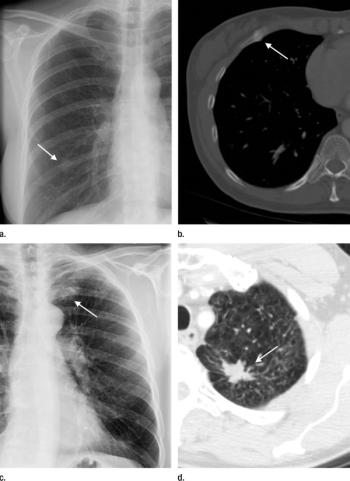
Chest CT follow-ups recommended by radiologists following chest radiograph result in clinically relevant findings.
Computer-generated patient histories are more thorough, organized, and useful than physician-written histories.

Routinely adding ultrasound to screening for breast cancer for women with dense breasts is not cost-effective.
Using a structured order entry for trauma CTs results in better communication, recording, and billing.
Screening mammography image readings by radiologists are influenced by individual technologists.
Magnetic resonance imaging has shown changes in the brain among smokers who relapsed within seven days of quitting.
Radiology managers are still skeptical about receiving adequate reimbursement from Medicare.

CT images help identify patients who may have a subsequent stroke within three months of experiencing a TIA.

Moms with placenta accreta who undergo insertion of prophylactic arterial balloons reduce risk of complications with delivery and future fertility.
Chest radiographs ordered for children, particularly for indications such as syncope or dizziness, do not alter the course of treatment.
Lung cancer screening based on PLCOm2012 model criteria is more effective than the USPSTF criteria.

Check out who won the Top People to Watch in Radiology - 2014 contest.
Making imaging records available to patients allows them to participate in their medical care.
Mammography done on a risk-based approach among women in their forties misses a significant number of cancers, of which many are invasive.
Adding tomosynthesis to screening mammography improves the detection rate for women with dense breast tissue.